
Sole Proprietorship vs. LLC: What They Didn't Teach You in Grad School
A practical breakdown for solo therapists deciding between a sole proprietorship and an LLC, with a focus on liability, risk, and when it is time to upgrade.
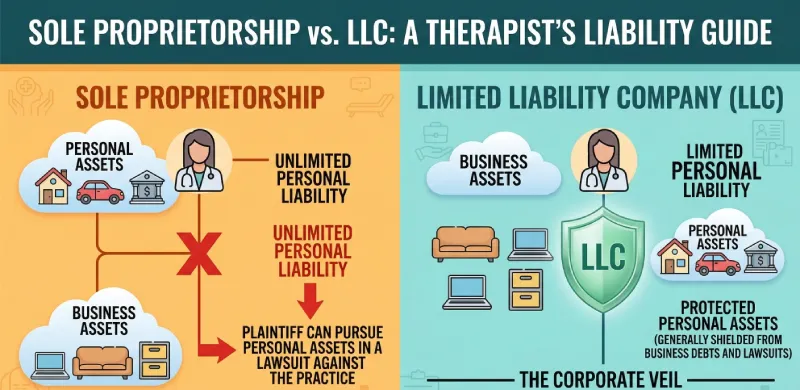
For a solo therapist, a sole proprietorship works only in the earliest, lowest-risk stage of practice: it is the simplest structure to run, but it leaves your personal savings, car, and home fully exposed if your business is sued or owes debt. Once you practice full-time, sign commitments like a multi-year commercial lease, treat higher-acuity clients, or hold assets you cannot afford to lose, forming an LLC is the step that legally separates your personal property from your practice.
Grad school covers theories, ethics, and clinical modalities; it rarely covers how to structure the business behind them. Most new solo therapists therefore default to a sole proprietorship because it is easy, even though that default carries real risk as the practice grows.
The sections below cover the definitions, the actual risks, and the benefits using current data, so you can make a sound call for your future.
The Default Setting: The Sole Proprietorship
If you are seeing private-pay clients under your own name and have not filed paperwork with your state, you are legally a sole proprietor. There is zero legal distinction between you, the person, and your practice, the business [1].
Therapists choose this structure because it is the path of least resistance. You avoid heavy paperwork and skip the state filing fees in most places. Come tax season, you put your business income on your personal 1040 using a Schedule C [2]. When you are bootstrapping your startup and counting every penny, that simplicity is appealing.
The risk is the same lack of distinction between you and the business [1]. In a sole proprietorship, your personal liability is unlimited.
If a client sues you, or if you accidentally break a commercial office lease, the claim can reach past your office couch and business laptop into your personal savings, your car, and even your house. Malpractice insurance is a must-have, but it does not fix the fundamental vulnerability of this structure.
The limited liability company (LLC)
For a solo practitioner, the main reason to form an LLC is to build a legal wall around your personal assets.
An LLC is a flexible structure that combines features of a corporation with those of a sole proprietorship [1]. The benefit is right there in the name: limited liability. The law places a corporate veil between you and your practice.
If your LLC is set up and maintained correctly, a lawsuit against your practice generally only threatens the assets owned by the LLC. Your personal checking account, your family home, and your car stay outside that boundary [1]. Small business data shows the LLC is the most common structure for single-member businesses [3]. You get the legal protection without the heavier formalities of a full corporation.
Which one should you choose?
There is not a universally right answer here. It is entirely about balancing risk against where you are right now.
Stick with a Sole Proprietorship if:
- You are only seeing a tiny handful of low-risk clients on the side.
- Cash flow is tight and you cannot yet cover the state LLC filing fees, which run anywhere from $50 to over $500 depending on where you live.
- You have rock-solid professional liability insurance, and you fully accept that it does not replace the legal wall an LLC builds.
It is time to upgrade to an LLC if:
- You are taking this full-time.
- You are taking on real business debt, like signing a multi-year commercial lease.
- You treat higher-acuity clients, where the statistical risk of a legal complaint is a real possibility.
- You own significant personal assets, like a house or a large retirement account, that you cannot afford to lose.
The CEO's take: peace of mind equals better therapy
We owe it to the people sitting across from us to be ethical and organized. We also owe ourselves legal protection.
Staying a sole proprietor might save you $300 in filing fees today. In a worst-case scenario, a single claim could touch your entire retirement fund, which makes that $300 saving look small. Upgrading to an LLC is an investment in your own peace of mind: when you are not quietly worrying about your personal assets, you bring a more grounded, present version of yourself into the therapy room.
Once your legal foundation is locked in, secure the financial side. EasyMindCare helps solo therapists cut their monthly expenses.
If you are tired of paying perpetual software rent, contact us here. We will keep you in the loop on new guides and tools for solo therapists.
A disclaimer
I am the CEO of EasyMindCare, not an attorney or a CPA. What follows is for educational purposes, based on standard U.S. business practices. State laws vary widely. Always talk to a qualified professional in your specific jurisdiction before making major legal moves.