The Clinical Reality of Burnout: Why Solo Therapists Can’t Just "Self-Care" It Away
Burnout in solo practice is a physiological and structural issue—not a motivation problem—and recovery requires evidence-based redesign, not just self-care slogans.
Self-care will not fix your burnout. Bubble baths, yoga, and cognitive reframing cannot touch it, because burnout is a physiological injury caused by chronic workplace stress, and it only heals when you fix the structural causes: the caseload, the billing, the isolation. You hold space for severe trauma, then haggle with insurance companies, usually alone, and when the weight finally flattens you, the industry prescribes more self-care.
And what happens when you meditate, hit the gym, do your cognitive restructuring, and still wake up feeling a cold, heavy dread before your 8 AM client? Below is the actual, hard science of burnout: what it physically does to your brain, why standard-issue cognitive tricks fall flat, and what evidence-based recovery actually looks like.
1. Burnout is a physiological injury
Burnout is chronic workplace stress that has gone unmanaged; the WHO added it to the ICD-11 in 2019 as an "occupational phenomenon." Clinically, it shows up in three ugly ways:
- Exhaustion: the kind that settles in your bones and makes forming sentences feel like wading through wet concrete.
- Cynicism (Depersonalization): you start feeling numb, detached, or even resentful toward your clients.
- Inefficacy: a deep, nagging feeling that you're a fraud, or that your work doesn't even matter anymore, despite a literal wall of credentials saying otherwise.
The neurobiology: your jammed "off" switch
Chronic stress physically rewires your brain. Your HPA Axis (Hypothalamic-Pituitary-Adrenal) is built to dump cortisol when a tiger chases you, then shut off once you're safe. With burnout, that switch gets jammed in the "on" position. Your body gets battered by allostatic load, constant wear and tear. Over time, marinating in cortisol literally enlarges your amygdala (making you hyper-sensitive to threats) and thins out your prefrontal cortex (killing your logic and emotional regulation).
Ever wonder why you can't stop obsessing over clinical notes at 2 AM? It's a network glitch. A healthy brain toggles smoothly between the Task-Positive Network (for getting things done) and the Default Mode Network (for resting and daydreaming). It's a seesaw. But chronic stress breaks the hinge. Your Default Mode Network starts intruding while you're trying to work, giving you terrible brain fog. Then, when you finally hit the pillow, the Task-Positive Network refuses to power down. You're wired, yet totally exhausted.
2. Why you can't "CBT" your way out
You're a therapist. You know CBT works wonders for a lot of things. But trying to treat your own burnout with cognitive restructuring is like putting a Band-Aid on a broken leg. You're treating a symptom while completely ignoring the toxic environment causing it.
Burnout is an environmental problem. If you use person-directed interventions (like resilience training or CBT) to fix an organizational issue, the benefits evaporate in about six months. Why? Because the root cause is still sitting there waiting for you on Monday morning.
The JD-R model: demands vs. resources
Organizational psychology breaks this down beautifully with the Job Demands-Resources (JD-R) model. Work is made of Demands (stuff that drains your battery, like crisis calls or chasing unpaid invoices) and Resources (stuff that recharges you, like a supportive peer group, clinical autonomy, and decent pay). Burnout hits when your demands are through the roof and your resources are scraping the bottom of the barrel.
Dr. Christina Maslach, the undisputed heavyweight champion of burnout research, pinpointed six specific mismatches that ruin our work lives. As a solo practitioner, you are both the worker and the workplace architect. Where is your practice mismatched?
- Workload: is your caseload simply frying your nervous system?
- Control: are insurance panels dictating how you practice?
- Reward: effort-reward imbalance predicts burnout with terrifying accuracy. Are you financially starving while doing incredibly heavy emotional lifting?
- Community: solo practice is incredibly lonely. Do you actually have peers to consult with, or are you operating in a silo?
- Fairness: are you constantly battling unjust systems, like endless insurance clawbacks?
- Values: are you using a modality you hate, or seeing a population that drains you, just to pay the rent?
You can't "reframe" an abusive insurance contract. CBT won't fix a fundamentally unsustainable caseload.
3. The "stay or close" dilemma
When it gets really bad, almost every therapist starts daydreaming about tossing their license in the trash and opening a bakery.
If you decide to stay but change absolutely nothing, you're looking down the barrel of a "Loss Spiral." The exhaustion tanks your confidence. That drop in self-efficacy makes you disengage even more. The burnout compounds. It gets darker.
(A quick side note: if you ever read studies claiming therapists who "stay" are doing fine, watch out for the Healthy Worker Effect. It's a massive statistical illusion. The most burned-out people already quit and aren't in the data pool anymore.)
But just burning the practice to the ground isn't a magic cure, either. Real recovery takes deliberate, active intervention.
4. The science-backed recovery protocol
Actual recovery means psychophysiological unwinding. You have to shift from passive zoning-out to active, structural rebuilding.
Phase 1: Physiological triage
You can't heal your prefrontal cortex while your body thinks it's running from a bear.
- Sleep continuity: prioritize sleep quality over hours in bed. Waking up constantly keeps your stress axis wildly dysregulated.
- Vagus nerve reset: use the "physiological sigh," two quick inhales through the nose and one long exhale through the mouth. The data shows this physically drops your arousal state faster than standard mindfulness.
- The aerobic flush: get moving. Moderate, Zone 2 aerobic cardio actively repairs your fried neural pathways by boosting BDNF. It flushes out the exhaustion.
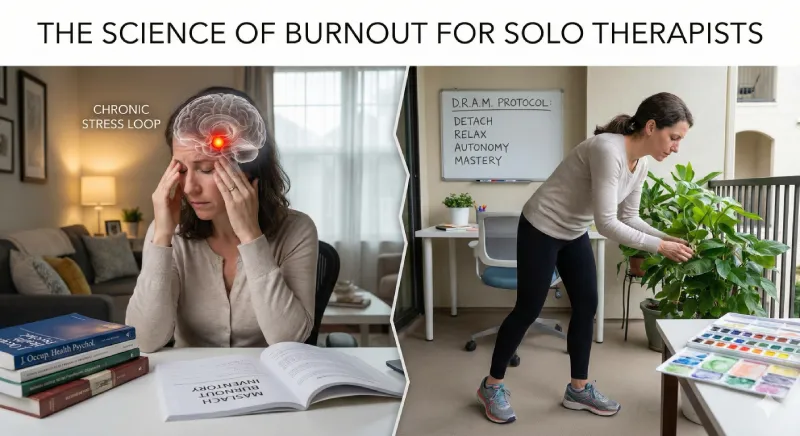
Phase 2: The D.R.A.M. framework (cognitive rest)
Psychologist Sabine Sonnentag found that true recovery requires four non-negotiable experiences:
- Detachment: you have to cut the cord. Thinking about a client while cooking dinner keeps the amygdala firing. Build ruthless shutdown rituals to close your clinical brain for the day.
- Relaxation: low-key stuff that tells your sympathetic nervous system to chill.
- Autonomy: do things where you call all the shots. Your clinical hours belong to your clients; your off-hours need to belong strictly to you.
- Mastery: pick up a challenging, totally non-clinical hobby. Build a birdhouse. Learn to code. Speak awful Italian. Mastery repairs the self-worth that burnout destroyed.
Phase 3: Non-verbal processing
Therapy is a highly cognitive, language-heavy profession. Trying to recover by talking even more is just going to drain your battery faster. Look into non-verbal processing. A randomized controlled trial found art therapy drastically cut emotional exhaustion in healthcare workers. It lets you process secondary trauma without the heavy cognitive lifting.
Phase 4: Structural redesign
Finally, you have to fix the house. Pull out the JD-R model and ruthlessly edit your practice. Decrease the demands. Cut your caseload. Fire the clients who drain the life out of you. Outsource the hellish billing. Or, increase your resources. Raise your rates. Join a consultation group. Guard your time off with your life.
Let's get one thing straight. Burnout does not mean you are a bad therapist. It means your physiological battery is dead, and the way you've built your practice is actively stopping you from recharging it. Run the four phases above, starting with physiological triage, and rebuild the structure that drained you in the first place.
For the clinicians who need to see the receipts (references)
- WHO Definition: World Health Organization. (2019). ICD-11 for Mortality and Morbidity Statistics.
- Brain Networks: Golkar, A., et al. (2014). "The influence of work-related chronic stress on the regulation of emotion and functional connectivity in the brain." PLoS One.
- CBT Limitations: Panagioti, M., et al. (2017). "Interventions to prevent and reduce physician burnout: a systematic review and meta-analysis." The Lancet.
- JD-R Model: Demerouti, E., et al. (2001). "The job demands-resources model of burnout." Journal of Applied Psychology.
- 6 Mismatches: Leiter, M. P., & Maslach, C. (2003). "Areas of worklife: A structured approach to organizational predictors of job burnout." Research in Occupational Stress and Well Being.
- Effort-Reward Imbalance: Siegrist, J. (1996). "Adverse health effects of high-effort/low-reward conditions." Journal of Occupational Health Psychology.
- Turnover Intention: Chen, H., et al. (2022). "Impact of Work Stress and Job Burnout on Turnover Intentions." Frontiers in Public Health.
- The Loss Spiral: Houkes, I., et al. (2015). "From Exhaustion to Disengagement via Self-Efficacy Change." Frontiers in Psychology.
- Healthy Worker Effect: Chowdhury, R., et al. (2017). "The Healthy Worker Effect." Indian Journal of Occupational and Environmental Medicine.
- Sleep Continuity: Ekstedt, M., et al. (2006). "Sleep physiology in recovery from burnout." Biological Psychology.
- Vagus Nerve/Sighing: Balban, M. Y., et al. (2023). "Brief structured respiration practices enhance mood and reduce physiological arousal." Cell Reports Medicine.
- Aerobic Exercise: (2024). "Effects of Aerobic Exercise on Burnout Syndrome: A Systematic Review." ResearchGate.
- D.R.A.M. Framework: Sonnentag, S., & Fritz, C. (2007). "The Recovery Experience Questionnaire." Journal of Occupational Health Psychology.
- Daily Detachment: Sonnentag, S., et al. (2014). "Burnout and Daily Recovery: A Day Reconstruction Study." Journal of Occupational Health Psychology.
- Art Therapy: (2023). "Art therapy to reduce burnout in healthcare professionals: A Randomized Controlled Trial." PMC.
- Job Crafting/Detachment: (2022). "The Role of Off-Job Crafting in Burnout Prevention." MDPI.